
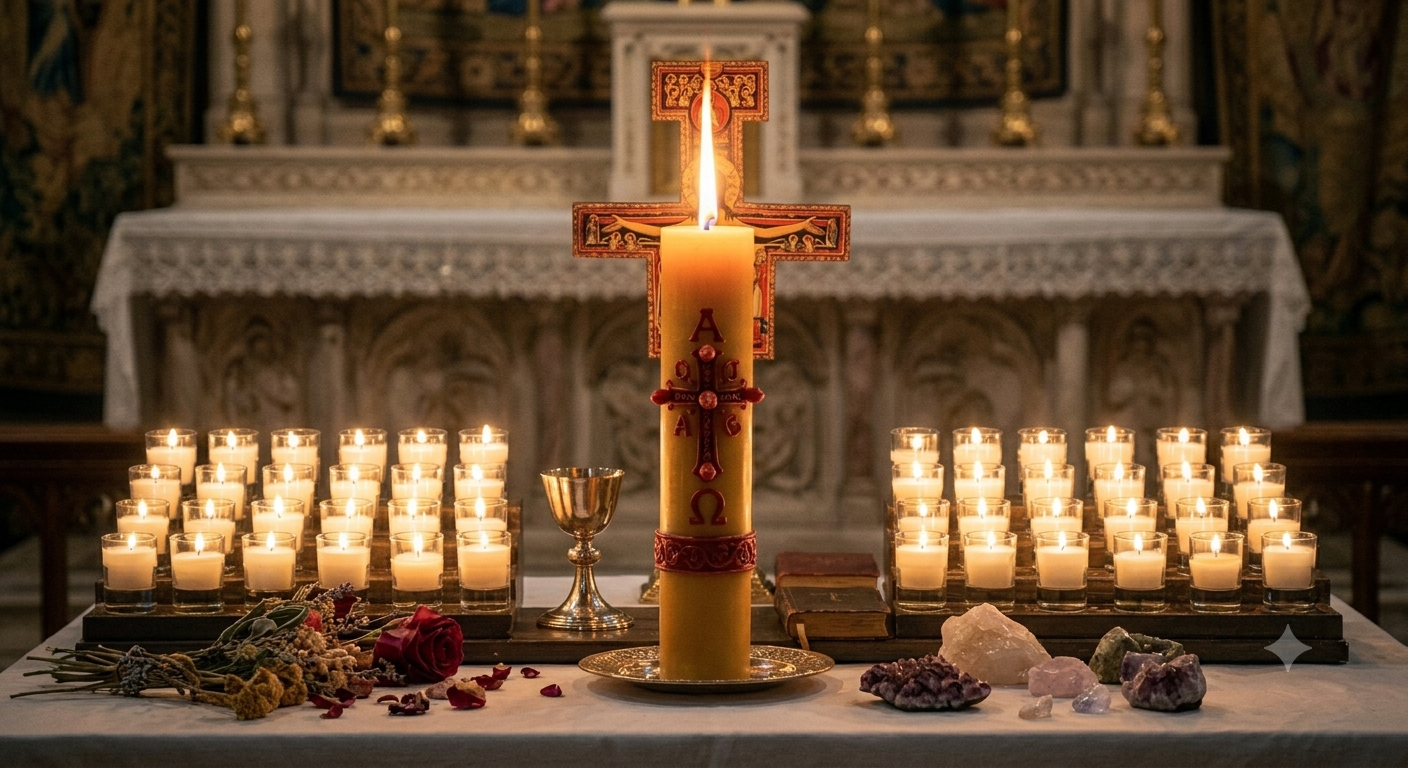
Step into any Christian place of worship across the globe—be it a grand Catholic cathedral, a time-honored Orthodox sanctuary, or a serene Protestant chapel—and the first element to capture your focus through the twilight is almost always the silent, flickering glow of candles.
Within two millennia of Christian liturgy, candles have never served as mere passive tools for physical illumination; they constitute a profound, living vocabulary of divine symbolism. From the subterranean catacombs where early believers hid from imperial persecution to the elevated, majestic altars of contemporary basilicas, the ritual of burning candles has been meticulously preserved. To understand the spiritual meaning of candles in Christianity is to comprehend how believers crystallize ungraspable faith into an eternal, dancing physical flame.
1. The Light of Christ: Illumination Against the Cosmos
In biblical theology, the stark polarity between light and shadow serves as the foundational narrative framework. In the Gospel of John (8:12), Jesus Christ explicitly declares to humanity: "I am the light of the world. Whoever follows me will never walk in darkness, but will have the light of life."
Consequently, every lit candle positioned upon an altar serves as an externalization of Christ's real presence (The Divine Presence). It stands as a continuous somatic reminder to the congregation that even within a material world filled with trial and spiritual ambiguity (darkness), the sovereign truth and redemption of God (light) remain unshakeable, guiding the soul back to its divine source.
2. The Mysticism of Pure Beeswax: Virginity and Total Sacrifice
Traditional Christian rubrics, particularly within Western Catholicism, enforced rigorous parameters regarding the composition of liturgical candles, decreeing that they must be crafted primarily from pure, natural beeswax. This requirement anchors a beautiful theological meditation developed by medieval scholastics:
-
The Immaculate Flesh: Because worker bees produce wax without mating, they were historicized in medieval bestiaries as absolute emblems of virginal purity. Thus, the pristine wax generated by these bees symbolizes the immaculate flesh of Christ, birthed from the spotless womb of the Virgin Mary. To mirror this tradition of absolute purity in your own sacred space, our collection of
[100% natural premium beeswax candles]offers a flawless, chemical-free energetic canvas. -
The Consuming Sacrifice: The cotton wick represents Christ's human soul, while the ascending flame embodies His absolute divinity. As the candle burns, weeping wax tears until its physical structure is entirely spent, it visualizes the reality of Christ's sacrifice on the cross—willingly pouring out His physical body to absorb the spiritual brokenness of humankind.
3. Externalizing the Unspoken Prayer: The Intercession of Votives
For millions of individual seekers crossing the threshold of a sanctuary, the lighting of a "Votive Candle" acts as an immediate, intimate conduit for conversational prayer.
Kneeling before icons or sacred altars, a believer ignites a small candle from the common flame. In theological terms, this physical act models the visionary liturgy recorded in the Book of Revelation (8:4): "The smoke of the incense, together with the prayers of God’s people, went up before God from the angel’s hand." Long after the petitioner exits the church, the flame they left behind continues to burn—standing as a silent proxy that represents their ongoing devotion. Creating a similar sacred anchor at home with [devotional prayer and intention candles] allows your personal intentions to continuously radiate within your personal sanctuary.
4. The Paschal Candle: The Ultimate Triumph Over Eternal Night
During Easter tide, the premier celebration of the Christian calendar, the symbolic magnitude of the candle reaches its liturgical zenith. At the opening of the Easter Vigil, the entire cathedral is deliberately plunged into total, crushing darkness, mimicking the existential silence of Christ's entombment.
From the darkness, the priest blesses a massive, ornately carved Paschal Candle, symbolizing the resurrected Christ. Carrying this lone beacon into the pitch-black aisle, the priest chants "Lumen Christi" (The Light of Christ), and slowly passes the fire to individual candles held by the congregation. Within minutes, thousands of micro-flames weave into a blinding ocean of light, effortlessly swallowing the darkness of the temple. This stunning visual alignment declares the ultimate message of Christian hope: life has trampled death, and the true light has conquered the night.
Conclusion
The candle within Christian tradition is a living matrix binding the secular to the sacred, the mortal flesh to the immortal spirit. Through its radiant warmth, it continuously preaches the ancient laws of life, self-giving sacrifice, redemption, and eternal alignment. Though human epochs shift, that trembling holy flame remains an unyielding compass for the modern soul seeking pristine peace.